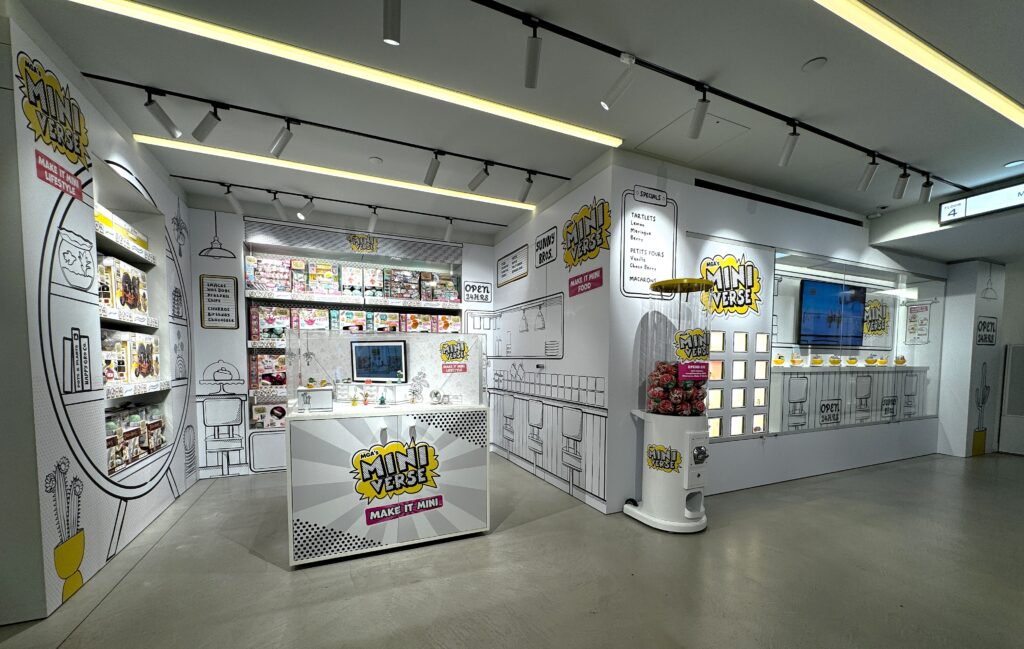
Every 2026 in-store brief lands on POS agency desks asking for the same three things. More sustainable. More digital. More standout. The reality on-shelf is more complicated.
If you’re planning your 2026 in-store calendar, the gap between brief and shelf is widening fast. Retailer guidelines have tightened. Material costs have shifted. Compliance teams are rejecting designs that would have passed two years ago.
This guide covers the point of sale display trends shaping UK retail in 2026. You’ll get a grounded view of what’s working, what’s getting rejected, and where to invest your next campaign budget.
What is a point of sale display?
A point of sale display is an in-store marketing structure positioned near where a purchase decision happens. It promotes a specific product, range, or campaign. Common formats include free-standing display units (FSDUs), counter display units, shipper trays, gondola ends, and dump bins.
In the UK, the terms POS and POP (point of purchase) are used interchangeably. Most brands and agencies treat them as the same thing.
The biggest POS display trends in 2026
Eight trends are defining POS display design 2026 in UK retail:
- Mono-material sustainable design becomes table stakes
- Retailer guidelines reset across grocery and high street
- Digital and interactive integration, with real constraints
- Modular and reusable display systems
- Data-led personalisation and regional variants
- Experiential and sensory in-store moments
- AI-assisted POS design and prototyping
- Omnichannel display zones around click-and-collect
Each trend is covered in detail below, with examples of what’s getting approved and what’s getting sent back.
1. Mono-material sustainable design becomes table stakes
Sustainability is no longer a value-add. It’s now a compliance requirement across most major UK retailers. Mixed-material displays are being rejected at supplier review.
Mono-material design means a display is built from a single recyclable material throughout. For most FSDUs, that’s FSC-certified corrugated board, water-based inks, and no plastic laminates.
What gets rejected in 2026:
- Plastic-laminated cardboard headers
- Mixed substrate constructions without clear separation points
- Foiling, glitters, or finishes that compromise recyclability
- Displays without FSC chain-of-custody documentation
The cost reality matters. Mono-material designs often run 15 to 30 percent higher upfront than legacy mixed-material builds. Smart design choices can claw back most of that gap, but only if your supplier engineers for material efficiency from day one.
According to WRAP UK, retailer-led recyclability scoring is now standard across the top grocery groups. Brands that ignore it will see displays returned before they reach shelf.
2. The UK retailer guideline reset
UK retailers have rewritten their POS guidelines for 2026. Most generic trend reports miss this entirely. They cover global shopper marketing without the compliance detail UK brands actually need.
Four shifts to plan around:
- Smaller footprints. Aisle FSDUs are being scaled down to free up walkways and improve store flow.
- Weight reductions. Single-person handling limits are being enforced more strictly across grocery.
- End-of-life scoring. Suppliers are scored on how easily store colleagues can break down and recycle units.
- Longer lead times. Compliance reviews now sit earlier in the process, pushing back tooling commitments.
If you brief your POS supplier at the same lead time you used in 2023, you’re already late. Add at least three weeks for retailer-side review on any new structural design.
The British Retail Consortium publishes ongoing updates on supplier sustainability commitments. It’s worth checking against your campaign timeline before you sign off creative.
3. Digital and interactive integration, with real constraints
Digital POS works in specific environments. It struggles in others. The 2026 trend is hybrid cardboard plus digital units, not full-screen takeovers.
Screens, NFC tags, and QR codes earn their place in beauty, premium drinks, and electronics. Dwell time supports the technology. In grocery aisles, shoppers move too fast for screens to pay back the cost.
Practical wins this year:
- QR codes linking to recipe content or product comparisons
- NFC tags for loyalty integration in beauty and skincare
- Compact battery-powered screens on premium drinks plinths
Power supply remains the biggest blocker. Most UK retailers won’t approve mains-powered POS in aisle locations. Plan for battery or solar from the start.
4. Modular and reusable display systems
Modular systems are the budget-friendly answer to rising sustainability costs. A reusable frame takes swappable graphic panels across multiple campaigns.
The numbers work. Spread tooling across three or four campaigns and your cost-per-deployment drops sharply. Retailers favour it because waste reduces at end-of-life.
Design constraints to plan for:
- Graphics must work within fixed frame dimensions
- Brand teams need to commit to a longer-term visual system
- Logistics need refining for return, refurb, and redeployment
Modular thinking suits brands with regular promotional cycles. It’s less suited to one-off seasonal hits where the structure itself is the creative.
5. Data-led personalisation and regional variants
Digital print is making smaller runs viable. Brands are moving away from one national display toward regional or store-cluster variants.
A drinks brand might run different displays in Scotland versus the South East. A snack brand might trial bilingual graphics in specific London catchments. The conversion lift can justify the operational complexity.
Where it works best:
- Pricing or pack variants by region
- Language or cultural relevance in mixed catchments
- Store-format-specific messaging (convenience versus large format)
The trade-off is operational. More variants mean more SKUs, more logistics complexity, and tighter forecasting. Brief your agency on segmentation before they start design.
6. Experiential and sensory in-store moments
Experiential POS earns its budget in beauty, premium drinks, and gifting. Sampling integration, tactile materials, and scent triggers are all back on the brief.
The 2026 version is more restrained than the bay-takeover budgets of 2018. Think a tactile finish on a counter display, a discreet scent diffuser on a beauty stand, or a sampling pocket built into the FSDU itself.
This is where Creators and Makers sees the biggest gap between brief and approval. Sensory elements often fail retailer hygiene or shopper-safety review. Test early.
7. AI-assisted POS design and prototyping
AI tools are accelerating early-stage POS design. Brand teams use them to generate mockups, test creative directions, and align stakeholders before committing to tooling.
Where AI helps right now:
- Generating visual concepts for internal brand reviews
- Producing variant treatments fast for campaign planning
- Drafting pre-production renders for retailer pitch decks
Where it falls short. AI mockups regularly show structures that can’t be built, materials that can’t be retailer-approved, or proportions that won’t fit shelf. Treat them as creative direction, not engineering.
The agencies winning here are the ones bridging AI ideation and physical production reality. That bridge is where most projects stall.
8. Omnichannel display zones around click-and-collect
Click-and-collect zones are now prime marketing real estate. Shoppers stand there waiting. UK retailers have started accepting branded POS in those spaces.
The opportunity sits in cross-promotion. A shopper collecting one product can be served impulse buys, loyalty offers, or new range messaging. Display design needs to suit a queueing audience, not a passing aisle shopper.
Key considerations:
- Vertical formats that don’t block walkways
- Messaging optimised for 30 to 60 seconds of dwell time
- QR integration for direct-to-basket add-ons
How UK brands should prioritise POS investment in 2026
Compliance comes first. Get the material, footprint, and end-of-life requirements right before you spend budget on creative or technology.
A simple framework for prioritisation:
| Category | Pre-2024 expectation | 2026 expectation |
|---|---|---|
| Material | Cardboard with plastic laminate | Mono-material FSC board |
| Footprint | Standard aisle FSDU | Reduced footprint, store-flow friendly |
| Lead time | Six to eight weeks | Nine to twelve weeks (compliance review added) |
| End-of-life | Disposal not assessed | Recyclability scored by retailer |
| Digital | Optional add-on | Hybrid expected in premium categories |
Brief earlier. Spec mono-material from the start. Build your campaign around what gets approved, not what looks good in the mockup.
Frequently asked questions about POS display trends 2026
What is the difference between POS and POP displays?
POS (point of sale) and POP (point of purchase) are used interchangeably in UK retail. Strictly, POS refers to displays near checkouts, while POP refers to any in-store display where purchase decisions happen. Most UK brands and agencies treat them as the same thing.
Are cardboard POS displays still effective in 2026?
Yes. Cardboard POS displays remain the most effective format in UK retail. They’re cost-efficient, recyclable, and design-flexible. The 2026 shift is toward mono-material cardboard construction, with no laminates or mixed plastics, to meet retailer sustainability requirements.
How much does a POS display cost in the UK?
POS display costs vary based on format, materials, print finish, and run size. A simple shipper tray starts at a few pounds per unit at volume. A bespoke FSDU with digital integration can run into the hundreds. Mono-material and modular designs are reshaping cost models in 2026.
What makes a POS display sustainable?
A sustainable POS display uses a single recyclable material throughout, with FSC-certified board, water-based inks, and no plastic laminates. It’s designed for easy breakdown in-store. Retailers now score suppliers on recyclability, weight, and end-of-life disposal as part of their compliance review.
How are UK retailers changing POS guidelines in 2026?
UK retailers have tightened POS guidelines around materials, footprint, weight, and end-of-life recyclability. Lead times have extended to allow for compliance review. Suppliers are now scored on how easily store colleagues can break down and recycle units after each campaign.
Planning your 2026 in-store calendar
The brands winning shelf in 2026 are the ones briefing earlier and specifying smarter. Compliance is no longer a back-end checkpoint. It shapes design from the first sketch.
Creators and Makers delivers POS for major UK retailers across grocery, beauty, and high street. If you’re planning your 2026 in-store calendar, speak to our team about turning these trends into displays that pass compliance and perform on shelf.
Which of these trends matters most for your category next year?