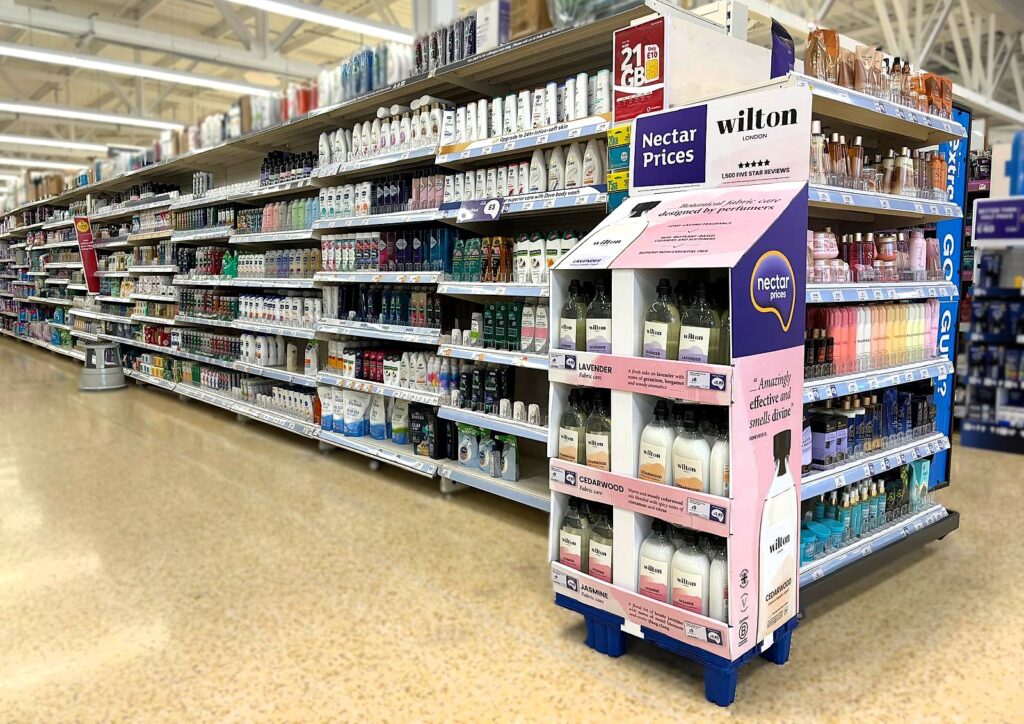
You’ve received a retailer brief that mentions an FSDU. Now you want a clear explanation rather than industry shorthand.
FSDU design refers to the structural and visual creation of free standing display units used in retail. These are the branded, self-supporting stands you see at aisle ends, store entrances and queue zones.
This guide explains what an FSDU is, the main types, how good ones are designed and made, and what separates a strong unit from one that fails in store. It’s written from 16 years of building FSDUs for brands sold through Tesco, Hamleys and Harrods.
What Is an FSDU?
An FSDU (Free Standing Display Unit) is a self-supporting retail display that sits on the shop floor, separate from fixed shelving. Brands use FSDUs to merchandise products in high-traffic zones such as aisle ends, store entrances and promotional areas, where they attract attention and drive sales.
Unlike shelf-ready packaging or counter displays, an FSDU stands on its own without being fixed to walls or gondolas. It’s designed to be both a structural product holder and a piece of brand communication.
Most FSDUs are commissioned for a specific campaign, retailer or promotional window. Some are temporary cardboard builds. Others are permanent metal or timber fixtures built to last several years.
What Does FSDU Stand For?
FSDU stands for Free Standing Display Unit. The term is widely used across UK retail, particularly within FMCG, grocery, health and beauty, and toys categories.
You’ll often see FSDU mentioned alongside related point-of-sale acronyms. Here are the most common ones worth knowing:
- CDU — Counter Display Unit. Smaller, sits on a counter or till point.
- PDQ — Pretty Darn Quick. A shelf-ready tray for fast merchandising.
- SRP — Shelf Ready Packaging. Outer packaging designed to go straight onto shelves.
- POS — Point of Sale. The umbrella term covering all in-store display formats.
Types of FSDU
FSDUs fall into three main categories based on lifespan and materials. Each suits a different campaign objective and budget.
Temporary FSDUs
Temporary FSDUs are made from corrugated cardboard and built for short campaigns of two to twelve weeks. They ship flat-packed for efficient distribution and are usually recyclable at end of life.
These are the most common format for product launches, seasonal pushes and tactical promotions. Unit costs are low, which makes them suitable for high-volume retailer rollouts.
Semi-Permanent FSDUs
Semi-permanent units use heavier board, foamboard or lightweight composite materials. They typically last three to six months in store.
Brands choose these for longer seasonal campaigns or category launches where the unit needs to hold up to repeated handling and restocking.
Permanent FSDUs
Permanent FSDUs are built from metal, timber or composite materials. They are designed for multi-year placement and represent a larger upfront investment.
Category brands with long-term retailer presence often use permanent units. Think premium spirits in supermarkets or licensed product stands in toy stores.
FSDU Comparison Table
Here’s how the three types compare across the factors that usually drive the decision:
| Type | Material | Lifespan | Typical Use |
|---|---|---|---|
| Temporary | Corrugated cardboard | 2 to 12 weeks | Product launches, seasonal promotions |
| Semi-permanent | Heavy board, foamboard | 3 to 6 months | Extended seasonal campaigns |
| Permanent | Metal, timber, composite | 1 to 5 years+ | Long-term category fixtures |
Why Brands Use FSDUs
Brands use FSDUs because they break the visual monotony of fixed shelving and give a product its own dedicated space in store. That visibility translates directly into uplift during a campaign window.
There are five core commercial reasons behind the investment:
- Off-shelf visibility. Products stand out from the crowded shelf environment and catch the shopper’s eye.
- Brand storytelling. Units carry richer creative than packaging alone can deliver.
- Flexible placement. Aisle ends, entrances and promotional zones can be negotiated with the retailer.
- Launch support. New products gain shelf presence before they earn permanent listings.
- Measurable uplift. According to POPAI UK research, in-store displays drive significant sales lift versus standard shelf placement.
For a brand manager defending the budget internally, an FSDU is often the most cost-effective way to win shopper attention at the moment of purchase.
How an FSDU Is Designed and Made
Strong FSDU design follows a six-stage process. Skipping any stage tends to show up as a problem in store.
- Brief. The retailer, product weight, dwell time and campaign objective are captured upfront.
- Structural CAD design. Load-bearing calculations and base footprint are worked out before any print artwork is applied.
- Prototyping. A physical mock-up is built and reviewed against the brief.
- Weight and stability testing. The prototype is loaded with real product and tested for tilt, stability and retailer compliance.
- Print and finishing. Artwork is produced using litho, digital or screen print depending on quantity and finish.
- Flat-pack engineering. The final unit is engineered to ship flat and assemble quickly in store.
On one Hamleys campaign, we redesigned a top-heavy toy FSDU during prototyping after stability testing revealed it tipped under a half-loaded condition. Catching that on the workshop floor saved the brand a costly retailer recall.
Major UK retailers including Tesco, Sainsbury’s and Boots run their own FSDU compliance specifications. These cover dimensions, fire-retardancy and structural integrity. Good design accounts for these specs from the first sketch, not the final sign-off.
What Makes a Good FSDU Design
A well-designed FSDU meets five practical criteria. Use these when reviewing supplier proposals.
- Stability. It passes weight and tilt testing with the product fully loaded.
- Retailer compliance. It meets the dimensions, fire safety and structural specs of the destination retailer.
- Brand fidelity. Print quality, colour accuracy and structural integrity match the original creative.
- Ease of assembly. Store teams can build it in under five minutes without instructions.
- Sustainability. The unit uses mono-material construction and recyclable components where possible.
A common failure point is units that look strong in a render but fail under real product weight. Always ask your supplier whether weight testing happens in-house before sign-off.
How Much Does an FSDU Cost?
FSDU costs vary widely. Pricing depends on materials, print method, run length and complexity, so headline figures rarely tell the full story.
Six factors drive the final cost:
- Material choice. Cardboard is cheapest. Metal and timber sit at the top end.
- Artwork complexity. Multiple print panels and bespoke shapes add to tooling costs.
- Print method. Litho is cost-effective at volume. Digital suits shorter runs.
- Quantity. Per-unit costs fall sharply as run length increases.
- Assembly. Pre-assembled units cost more than flat-pack equivalents.
- Delivery and storage. Bulk distribution and warehousing add overhead.
Typical lead times from brief to delivered units run from four to eight weeks. Permanent or bespoke builds usually take longer.
Are FSDUs Sustainable?
Most cardboard FSDUs are recyclable, but recyclability depends heavily on design choices made at the brief stage. Sustainable FSDU design comes down to material selection and finishing.
Four design choices make a measurable difference:
- Mono-material construction. Single-material units recycle far more easily than mixed builds.
- FSC-certified board. Material sourced from responsibly managed forests reduces upstream impact.
- Water-based inks. These avoid the contamination issues caused by solvent-based alternatives.
- Avoiding plastic laminates. Laminates compromise recyclability and should be specified only where strictly needed.
UK retailers increasingly ask suppliers to evidence sustainable design choices. WRAP guidance on packaging waste is a useful reference point for brand managers building the case internally.
Frequently Asked Questions
What is the difference between an FSDU and a CDU?
An FSDU sits on the shop floor and holds larger volumes of stock. A CDU (Counter Display Unit) sits on a counter or till point and holds smaller, impulse-purchase items. Both are point-of-sale displays, but FSDUs are larger and typically used for primary campaign activity.
How long do FSDUs last in store?
Temporary cardboard FSDUs typically last two to twelve weeks. Semi-permanent units last three to six months. Permanent FSDUs built from metal or timber can stay in store for several years. Lifespan depends on materials, handling and retailer environment.
Are FSDUs made of cardboard?
Most temporary FSDUs are made from corrugated cardboard, which is cost-effective, lightweight and recyclable. Semi-permanent units often use heavier board or foamboard. Permanent FSDUs are typically built from metal, timber or composite materials for longer in-store life.
Why do supermarkets use FSDUs?
Supermarkets use FSDUs to create high-impact promotional zones, support brand campaigns, and drive impulse purchases. The units give brands dedicated floor space outside fixed shelving, which improves visibility and supports retailer category goals during peak trading periods.
Who designs FSDUs?
FSDUs are designed by specialist POS agencies and manufacturers with in-house structural design, prototyping and production capabilities. Good FSDU partners handle CAD engineering, weight testing, print and flat-pack production under one roof, which keeps quality control tight and lead times short.
Briefing Your Next FSDU With Confidence
FSDUs are one of the most effective ways for a brand to win attention in store. The right unit pairs strong creative with sound structural engineering, retailer compliance and sustainable design.
When you brief your next FSDU, ask suppliers about in-house CAD, prototyping and weight testing. Those three capabilities separate displays that perform from displays that fail.
Creators and Makers has 16 years of experience designing and producing FSDUs for brands sold through Tesco, Hamleys and Harrods. If you’re scoping a campaign and want to talk through structural or design options, get in touch with our team.