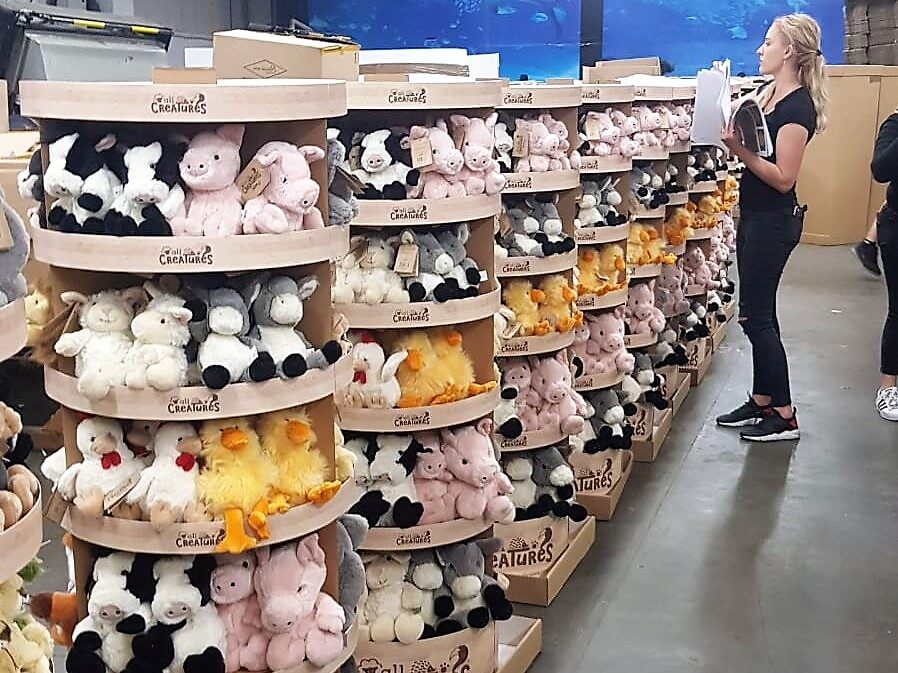
You have been briefed to deliver an in-store activation for next quarter. The retailer wants an FSDU, the brand team wants impact, finance wants it cheap, and logistics wants it yesterday.
Anyone who has shipped a campaign knows where the real gap sits. It lies between a strong FSDU brief and a strong FSDU in-store. Good FSDU design is not just a print job. It sits at the intersection of design, engineering, logistics, and retailer compliance.
Miss any one of those four and your campaign lands two weeks late, or worse, gets pulled from the fixture. This guide walks you through everything that goes into a successful FSDU: materials, costs, lead times, retailer specs, and installation. By the end, you will brief better, spend smarter, and land your campaign.
In short
A free-standing display unit (FSDU) is a floor-standing retail display used to promote a product, range, or campaign in a high-traffic area of a store. Producing one involves concept design, structural engineering, prototyping, weight testing, print, flat-pack distribution, and in-store installation. Expect a six to ten week timeline for a bespoke unit.
What is an FSDU?
An FSDU, or free-standing display unit, is a floor-standing retail display used to promote a product or range in-store. FSDUs are typically made from cardboard, foamex, or metal. They ship flat-packed and install at aisle ends, store entrances, or promotional zones.
The acronym stands for free-standing display unit. Each unit is self-supporting and sits on the shop floor. It is distinct from shelf-edge POS, gondola ends, and counter display units.
Shops across the UK rely on them. You will see FSDUs in grocery multiples, pharmacies, DIY sheds, toy shops, and electronics retailers. Brands also use them at trade shows and pop-up activations.
Its purpose is simple. An FSDU gives a product or promotion dedicated space outside the standard planogram. That space is fully brand-controlled and ranks among the most valuable real estate in-store.
How does it differ from similar formats? A CDU sits on a counter and targets impulse purchases at the till. A dump bin holds loose product in bulk. FSDUs hold stock in an organised, branded way on the shop floor.
Why Brands Use FSDUs
Brands use FSDUs because they deliver uncontested in-store visibility that standard shelf space cannot match.
When an FSDU is the right choice:
- You are launching a new product and need to break shopper autopilot
- You have a seasonal campaign that needs temporary, high-impact space
- You have secured promotional investment space from a retailer
- You want full creative control over how your product is presented
- Your product benefits from impulse purchase behaviour
Commercial logic is straightforward here. A shopper walking the planogram sees your product next to competitors. Move that product onto an FSDU and the competition disappears. Facings grow and the brand message takes centre stage.
Retailers often grant FSDU space in exchange for promotional investment, listing fees, or over-and-above performance. Trade marketing teams know this trade-off well. Strong briefs and reliable delivery protect the space for next season.
Creative control is the second benefit. Shelf space gives you a facing. An FSDU gives you a full canvas, from base plinth to header board.
ROI breaks down into four variables: footfall past the unit, conversion uplift, basket uplift, and days live in store. Subtract the amortised unit cost and you have your return. Industry bodies such as the Shop! Association UK publish shopper marketing benchmarks to sense-check your numbers.
Categories that lean hardest on FSDUs include confectionery, soft drinks, alcohol, beauty, health supplements, and seasonal toys. If your product sells on impulse or benefits from a launch moment, the format earns its place in the mix.
FSDU Materials Explained
FSDUs are most commonly made from corrugated cardboard, foamex, metal, wood, acrylic, or honeycomb reboard. Each material suits different campaign lengths, product weights, and budgets.
Below is a side-by-side view of the main options:
| Material | Typical lifespan | Relative cost | Best for |
|---|---|---|---|
| Corrugated cardboard | 1 to 12 weeks | Low | Short-term promotions, seasonal campaigns |
| Foamex / PVC | 3 to 12 months | Medium | Longer campaigns, higher traffic |
| Reboard honeycomb | 1 to 6 months | Low to medium | Heavy products, drinks bottles |
| Metal | 12 months plus | High | Permanent fixtures, premium brands |
| Wood | 12 months plus | High | Heritage and premium positioning |
| Acrylic | 6 to 24 months | High | Beauty and luxury categories |
Corrugated cardboard
Cardboard is the UK default for FSDUs. Most units at supermarket aisle ends use E-flute or B-flute corrugated board. It is cheap, fast to produce, and fully recyclable through standard UK waste streams.
Campaigns of one to twelve weeks almost always use cardboard. FSC-certified options are widely available if sustainability sign-off is part of your brief. Plastic-free construction is now standard with most UK manufacturers.
Foamex and PVC board
Foamex is a rigid PVC board. It holds up better than cardboard and suits campaigns of three months or longer. Higher-traffic store locations often call for it.
Trade-offs are cost and sustainability. Foamex is not kerbside recyclable and carries a higher per-unit cost than corrugated. Specify it when campaign length or retail environment genuinely demands extra durability.
Metal and wood
Metal and wood units are permanent fixtures. Beauty counters, electronics departments, and premium categories use them for multi-season display.
Lead times stretch longer and costs climb higher. When an FSDU needs to stay in store for a year or more, these materials pay back through reuse.
Acrylic
Acrylic delivers a premium, modern feel. It is common in beauty, luxury, and high-value electronics. Most acrylic FSDUs combine it with metal or wood for structural strength and a considered aesthetic.
Reboard and honeycomb board
Reboard is a honeycomb-structured cardboard. It is significantly stronger than standard corrugated while staying lightweight and recyclable.
Use it for heavy products such as glass bottles or canned drinks. Short-term and sustainable at the same time. Reboard also travels well on pallets with fewer transit failures than standard board.
How an FSDU Is Designed and Produced
Designing and producing an FSDU follows seven core stages: brief, concept, structural CAD, prototype, transit trial, production, and installation. A bespoke unit typically takes six to ten weeks end to end.
Stages run in this order:
- Brief and concept development
- 2D and 3D visualisation
- Structural engineering and CAD
- Prototyping and weight testing
- Transit trials
- Print and manufacture
- Flat-pack, distribution, and installation
Each stage works like this.
Step 1. Brief and concept development
Strong briefs cover your objectives, the SKUs going on the unit, the retail environment, budget, and target retailer. Suppliers who skip this stage make expensive assumptions.
Share SKU weights and dimensions early. Share your retailer manual if you have one. The more context the supplier gets up front, the fewer surprises appear later.
Step 2. 2D and 3D visualisation
Concept sketches move to 2D layouts, then to 3D CAD renders. You approve the look before anyone cuts cardboard.
Sign-off at this stage matters more than any other. Creative and commercial changes after this point cost time and money.
Step 3. Structural engineering and CAD
Structural CAD engineers the unit for the real world. That means footprint, shelf load, centre of gravity, stability under shopper interaction, and retailer specification compliance.
Point load matters as much as total load. A shelf holding 10kg of glass bottles behaves nothing like one holding 10kg of crisp packets.
Our gravity-fed off-shelf display for LOL Surprise is a good example. The structural challenge was controlling product release rate while keeping the unit stable as weight shifted.
Step 4. Prototyping and weight testing
Physical prototypes get loaded with your real product. We push, tilt, shake, and stress the unit the way a shopper and a merchandiser will.
Wobbles or sagging show up now, not in store. Prototype sign-off is the last point you can make structural changes without delaying launch.
Step 5. Transit trials
Transit trials simulate the pallet journey from factory to store. Flat-packed units get loaded, strapped, vibrated, and drop-tested to mirror DC handling.
Failed units never leave the factory. Passed units go to full production with confidence.
Step 6. Print and manufacture
Print and manufacture brings the artwork to life. UV litho and digital print run onto your chosen board. Die-cutting creates the structural cuts.
Assembly tooling gets built alongside the print run. The unit needs to flat-pack cleanly and rebuild in store without tools.
Step 7. Flat-pack, distribution, and installation
Units ship flat-packed on pallets, either direct-to-store or consolidated through a retailer distribution centre. Some go pre-filled with stock; others go empty for store staff to load.
Install teams handle the build and compliance photography. De-rig at campaign end belongs in the same service. For the full picture, see our in-house fulfilment and installation capability.
How Much Does an FSDU Cost in the UK?
Several factors drive FSDU cost in the UK: material, size, shelf count, print complexity, and order quantity. Low-volume premium units can run into thousands of pounds each. High-volume corrugated units reach low double-digit pounds per unit at scale.
Five main cost drivers:
- Material choice (cardboard vs foamex vs metal)
- Unit size and shelf count
- Print and finishing complexity (die-cut headers, lamination, foiling)
- Order quantity (tooling and setup amortise over the run)
- Distribution method (flat-pack vs pre-assembled, DTS vs DC)
Volume economics matter more than most buyers realise. A run of 10 bespoke metal units carries a high per-unit cost. Tooling and setup get amortised over just 10 pieces.
Finishing layers stack up fast. Standard flat print stays cheap. Die-cut headers, lamination, foiling, and spot UV each add a layer of cost and a day of lead time.
Distribution is the silent cost. Direct-to-store is faster but more expensive than DC consolidation. Pre-filled units cost more to assemble and ship than flat-packed empties.
To get an accurate quote, send your supplier: dimensions, SKU weights, shelf count, desired material, quantity, and distribution method. Vague briefs always come back as vague prices.
FSDU Lead Times and the UK Retail Calendar
Bespoke FSDU lead times run six to ten weeks. Standard or off-the-shelf designs turn around in three to five weeks.
Week-by-week timeline for a bespoke unit:
- Week 1: Brief and concept
- Week 2: 2D and 3D visualisation
- Weeks 3 to 4: Structural CAD and prototype
- Week 5: Prototype sign-off
- Weeks 6 to 7: Print and assembly
- Week 8: Distribution
- Weeks 9 to 10: In-store installation
Map that timeline against the UK retail calendar and clear brief-back dates appear:
- January range resets: brief by mid-October
- Easter activations: brief by January
- Summer and BBQ: brief by February
- Back-to-school: brief by April
- Halloween: brief by May
- Christmas: brief by July for most multiples
Working backwards from your in-store date, engage a supplier at least ten to twelve weeks out for a bespoke programme. Standard units move faster, but the time saved often costs creative control.
Christmas slots close early for a reason. The print and assembly industry runs out of capacity by September. Every brand fights for the same Q4 fixture space.
Designing to UK Retailer Specifications
UK retailers publish supplier manuals that set FSDU dimensions, weight stability, fire ratings, pallet configuration, labelling, and compliance rules. None of this is optional.
Major UK multiples including Tesco, Sainsbury’s, Asda, Morrisons, and Waitrose each maintain their own requirements. Pharmacy and health chains such as Boots and Superdrug enforce tighter footprint rules with a higher aesthetic bar.
Common compliance categories:
- Maximum footprint and height
- Stability under load and shopper interaction
- Fire-retardant materials in certain store environments
- EAN barcode and pricing label placement
- Transit packaging and pallet format
- Health and safety compliance documentation
Before you brief a supplier, ask your retailer buyer for:
- The current FSDU supplier manual
- Available footprint and in-store location
- Maximum height for your fixture
- Any fire rating requirements
- Transit packaging expectations
Confirm spec before concept sign-off, not after. A unit that fails retailer compliance at the DC gets rejected on the loading bay. You then pay for a redesign, a reprint, and a late delivery.
Done right at the brief stage, you save weeks. Done wrong, your campaign slips and the retailer remembers.
FSDU Installation and In-Store Fulfilment
Installation covers how the unit reaches the store and how it gets built. Compliance reporting back to the brand matters too. All three stages deserve attention.
Flat-pack is the UK default. Units ship flat on pallets and assemble in store, either by store staff or a merchandising team. Pre-assembled units cost more in transport but save time on install.
Two main distribution routes exist. Direct-to-store (DTS) delivers straight from your supplier to each store. DC-routed distribution consolidates through the retailer’s distribution centre. DTS runs faster and cleaner but costs more.
Merchandiser teams handle installs when speed or complexity matters. They arrive on agreed dates, build the unit, fill with stock if required, and photograph the finished display. Those photos go back to the brand as proof of placement.
De-rig is often forgotten in the original brief. Cardboard units get broken down and recycled. Reusable units get collected, stored, and refurbished for the next campaign. Factor de-rig into your budget or it will surprise you.
WRAP’s guidance on packaging and end-of-life routing covers cardboard and mixed-material POS if your procurement team needs a sustainability benchmark.
Common FSDU Briefing Mistakes to Avoid
Some mistakes show up again and again in FSDU briefs. Catch them early and your campaign runs smoother.
- Vague SKU data. Without real weights and dimensions, structural CAD becomes guesswork.
- No retailer manual. Skipping the supplier guide means rework after the first DC rejection.
- Signing off 3D visuals without a physical prototype. Screens lie; cardboard tells the truth.
- Under-specifying distribution. DTS vs DC changes cost and lead time. Decide early.
- Forgetting de-rig. Campaign ends, units sit in store, retailer charges back the brand.
- Booking too late. Ten weeks is the floor for bespoke, not the ceiling.
Fix these at the brief stage and you protect your budget, your timings, and your relationship with the retailer buyer.
FSDU Design in London
Retail displays destined for London carry extra demands. Expect tighter install windows, access restrictions, ULEZ, and out-of-hours delivery slots.
Carnaby, Covent Garden, Oxford Street, and Westfield carry flagship activations that set the creative bar for a brand. Trade show venues such as ExCeL and Olympia add further London-specific install volume.
Practical challenges matter. Loading bay bookings in central London can be weeks out. ULEZ compliance affects fleet choice. Out-of-hours installs at stores like Harrods or Hamleys need booked slots and install teams with the right retailer credentials.
Creators & Makers operates from Kent, 30 minutes from central London by road. That proximity supports same-day site surveys, rapid response installs, and tighter logistics than suppliers based further north. Recent London work includes the Disney Frozen 2 pop-up at Harrods and seasonal retail activations at Hamleys on Regent Street.
Running an FSDU activation in London this year? Engage a supplier with documented London retailer experience, not just a London postcode.
Frequently Asked Questions
What does FSDU stand for?
Free-standing display unit. It is a floor-standing retail display used to promote a product or campaign in a dedicated area of a store.
How long does it take to produce an FSDU?
Timelines run six to ten weeks from brief to in-store for a bespoke unit. Standard units turn around in three to five weeks. For range reset windows, brief suppliers at least ten to twelve weeks before your in-store date.
What is the difference between an FSDU and a CDU?
Placement is the key difference. An FSDU is floor-standing and lives at aisle ends or store entrances. A CDU, or counter display unit, sits on a countertop and targets impulse purchases at the till.
Are cardboard FSDUs recyclable?
Yes. Cardboard FSDUs are fully recyclable through standard UK waste streams. Most UK suppliers now offer plastic-free construction as standard. FSC-certified and recycled-content materials are widely available.
How much does an FSDU cost in the UK?
Cost depends on material, size, shelf count, finishing, and quantity. High-volume corrugated units reach low double-digit pounds per unit at scale. Low-volume metal or acrylic units run into thousands per piece.
Conclusion
Great FSDU work solves four problems at once: design, structural engineering, logistics, and retailer compliance. Suppliers who only handle one or two of those will cost you time you do not have.
For 16 years, Creators & Makers has handled all four in-house. We operate from a 30,000 square foot Kent facility, 30 minutes from central London. Brands including Hamleys, Harrods, LOL Surprise, and Turtle Wax trust us from concept through to in-store install and de-rig.
Planning an FSDU campaign this year? Book a call with our team through the Creators & Makers contact page. We will review your objectives, retailer requirements, and timing, then flag anything you need to tighten before briefing other suppliers.